
Crop Production and Management: A Beginner's guide to Agriculture

Our day starts with waking up, brushing our teeth, taking bath , other daily chores. To perform our everyday activities we need Energy!. And where does energy comes from? Food. Absolutely right, but where does the food comes from? Not only food, where does our basic needs like clothing, shelter , everything come from? . Yes, you're right .
AGRICULTURAL PRACTICES:
With the increase in population, the demand for food has also gone up. The availability of land for agriculture has been decreasing. Therefore, improved agricultural practices have to be introduced.
All the activities which are involved in the cultivation of crops from sowing to harvesting are known as agricultural practices
Science that deals with the growing of plants and animals for human use is called agriculture.
BASIC PRACTICES OF CROP PRODUCTION:
Production of crops involves several activities carried out by the farmers over a period of time. The activities are given below:
- Preparation of soil and sowing
- Adding manure and fertilizer
- Irrigation
- Protection from weeds
- Harvesting
- Storage and Marketing
Preparation of soil and Sowing:
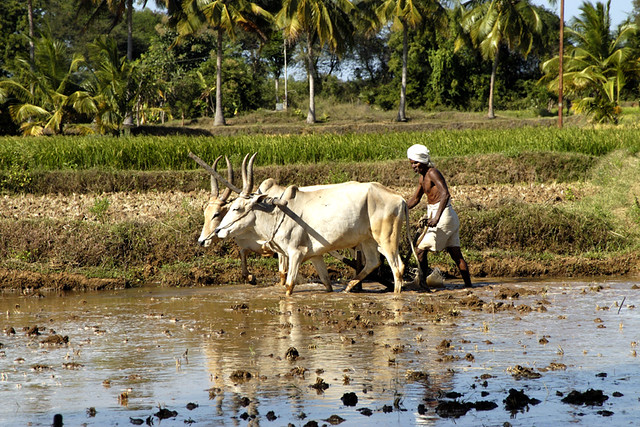
Before sowing the seeds, we have to prepare the soil. Preparation of soil is the first essential stage for cultivation of crops. Turning and loosening the soil involves,
- Ploughing or tilling
- Levelling and
- Manuring
 |
| Ploughing |
- Provides good aeration to roots
- Retains moisture for a long period
- Promotes growth of useful micro- organisms to bring nutrient rich soil to the top
- Helps in removal of undesirable plants(weeds).
 |
| Sowing |
IRRIGATION:
Plants need water for germination , drawing nutrients and preparing their food by photosynthesis.
The process of supplying water to crops in the field at different intervals is called irrigation. It varies from crop to crop, season to season and soil to soil.
Some of the sources of irrigation are well, tube wells, ponds, lakes, rivers, dams and canals.
Methods of irrigation:
1) Traditional method
- pulley system (moat)
- chain pump and
- lever system(rahat)
ii) Modern methods
 |
| Furrow irrigation |
 |
| Basin irrigation |
 |
| Sprinkler irrigation |
 |
| Drip irrigation |
PROTECTION FROM WEEDS:
Weeds are undesirable plants growing naturally along with the crop. Removal of these weeds is called weeding. Weeding should be done then and there.
 |
| Weedicide spraying |
Weeds must be removed because they compete with crops for water, nutrients, space and light thereby affecting their growth. The common types of weeds are grass, amaranthus, chenopodium
Methods of weeding:
 |
| Harvester combine |
HARVESTING:
The process of cutting and gathering a matured crop is known as harvesting.
In small farms crops are usual cut down using a hand held tool called sickle. In big farms a large vehicle called harvester combine is used.
Grains are separated from the stalk by the process of threshing. This is carried out by beating the cut stalks against hard floor or with a machine called mechanical thresher.
The chaff (pieces of straw and husk after threshing) is separated from the whole grain by winnowing.
 |
| Silo |
STORAGE AND MARKETING:
Grains are kept safe from moisture, insects and microorganisms. Farmers store grains in jute bags and metallic-bins. In a large scale the grains are stored in godowns, silos and granaries.
Fresh fruits and vegetables have much moisture content and thus they get spoilt soon. Therefore they are stored in cold storage.
MARKETING
 |
Increase in agricultural production alone will not bring about prosperity for farmers. It is important that agricultural products fetch a remunerative price. Warehousing and marketing facilities are essential to ensure this strategy.
Government has taken more steps to assist marketing of agricultural product and to promote the status of small farmers. Tamilnadu Government has established "Uzhavar Sandhai" to statisfy the need of consumers and the small scale village farmers.
Post a Comment